On Board systems of the ISS
the systems that act as the stations life support
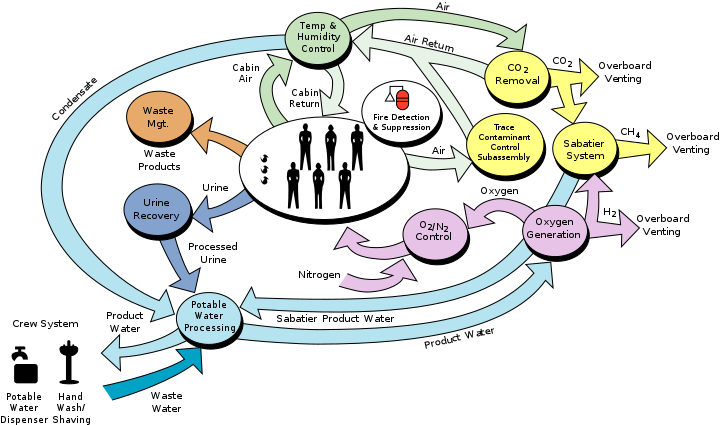
The critical systems that are the sole reason as to why life is even allowed to exist in the ISS make up the Environmental Control and Life Support System (ECLSS) and include the atmosphere control system that provides or controls atmospheric pressure and oxygen levels, the electrical power and thermal control system, the water supply system and the communication and computers systems as well as systems for fire detection and suppression along with waste management . The highest priority for the ECLSS is the ISS atmosphere, but the system also collects, processes, and stores both waste and water produced and used by the crew—a process that recycles fluid from the sink, shower, toilet, and condensation from the air.
The atmosphere control systems
Air revitalization system
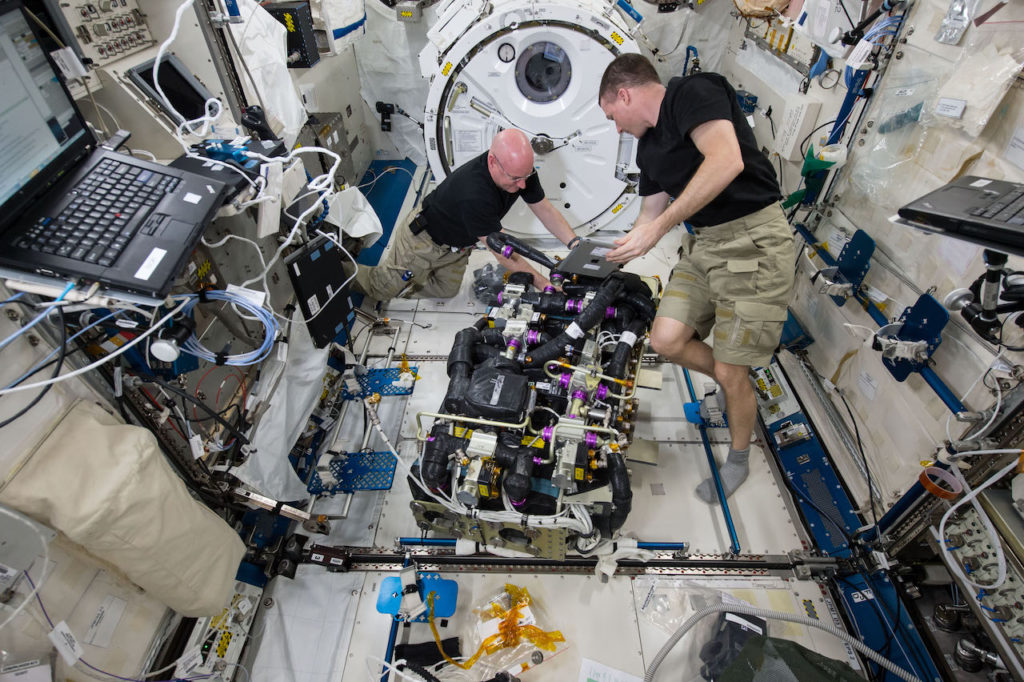
The Air Revitalization System removes carbon dioxide, controls trace contaminants and monitors the major constituents in the cabin atmosphere. Crew-generated carbon dioxide is removed from the atmosphere by sorbent beds (Carbon Dioxide Removal Assembly (CDRA)). The beds are regenerated upon exposure to heat and space vacuum. A Trace Contaminant Control System(TCCS) ensures that over 200 various trace chemical contaminants generated from material off-gassing and crew metabolic functions remain within allowable limits. A mass spectrometer (MCA) measures the oxygen, nitrogen, hydrogen, carbon dioxide, methane and water vapour content of the cabin atmosphere. This NASA rack is placed in Tranquility and was flown to the station aboard STS-128 and temporarily installed in the Japanese Experiment Module pressurised module during Space Shuttle Endeavour mission STS-130.
Oxygen Generating System
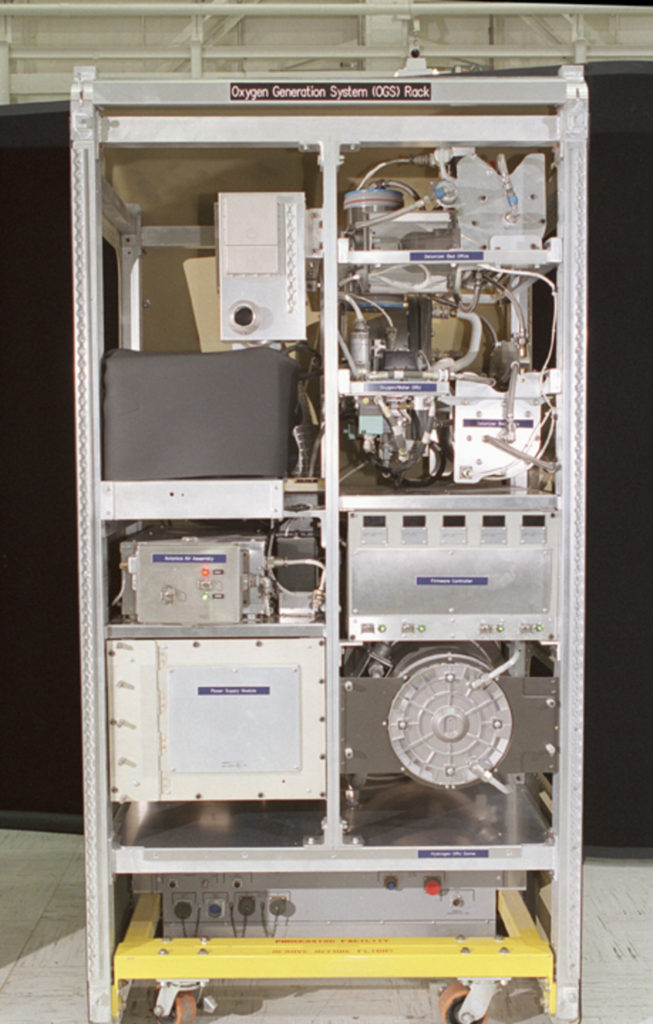
The Oxygen Generating System (OGS) is a NASA rack designed to electrolyse water from the Water Recovery System to produce oxygen and hydrogen. The oxygen is delivered to the cabin atmosphere. The unit is installed in the Destiny module. During one of the spacewalks conducted by STS-117 astronauts, a hydrogen vent valve required to begin using the system was installed. The system was delivered in 2006 by STS-121, and became operational on 12 July 2007.The Oxygen Generation System is designed to generate oxygen at a selectable rate and is capable of operating both continuously and cyclically. It provides up to 9 kg of oxygen per day during continuous operation and a normal rate of about 5.5 kg of oxygen per day during cyclic operation.
Sabatier System
The NASA Sabatier system, since 2010, closes the oxygen loop in the ECLSS by combining waste hydrogen from the Oxygen generating system and carbon dioxide from the station atmosphere using the Sabatier reaction to reuse the oxygen. The outputs of this reaction are water, and methane. The water is recycled to reduce the total amount of water that must be carried to the station from Earth, and the methane is vented overboard by the now shared hydrogen vent line installed for the Oxygen generating system. Prior to the activation of the Sabatier System in October 2010 hydrogen and carbon dioxide extracted from the cabin was vented overboard.

Elektron
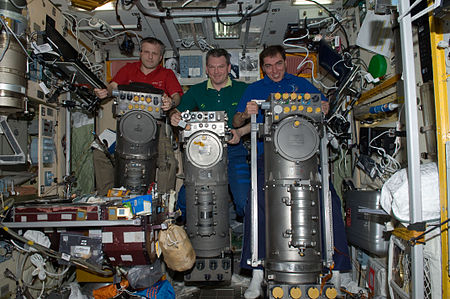
Elektron is a Russian Electrolytic Oxygen Generator, which was also used on Mir. It is the primary supply of oxygen and uses electrolysis to produce it. This process splits water molecules reclaimed from other uses on board the station into oxygen and hydrogen, then the oxygen is vented into the cabin and the hydrogen is vented into space. The three Russian Elektron oxygen generators on board the International Space Station have been plagued with problems, frequently forcing the crew to use backup sources (either bottled oxygen or the Vika system discussed below). To support the crew, NASA added the oxygen generating system discussed above. The 1 kW (1.3 hp) system uses approximately one litre of water per crew member per day. This water is either brought from Earth or recycled from other systems. Mir was the first spacecraft to use recycled water for oxygen production.
Vika
The secondary oxygen supply is provided by burning oxygen-producing Vika cartridges, also known as Solid Fuel Oxygen Generation (SFOG) . Each ‘candle'(canisters of solid lithium perchlorate) takes 5–20 minutes to decompose at 450–500 °C (842–932 °F), producing 600 litres (130 imp gal; 160 US gal) of O2. Each canister can supply the oxygen needs of one crewmember for one day. This unit is manually operated. It was originally developed by Roscosmos for Mir.
Vozdukh
Another Russian system, Vozdukh (Russian Воздух, meaning “air”), removes carbon dioxide from the air based on the use of regenerable absorbers of carbon dioxide gas.
chemical oxygen generator
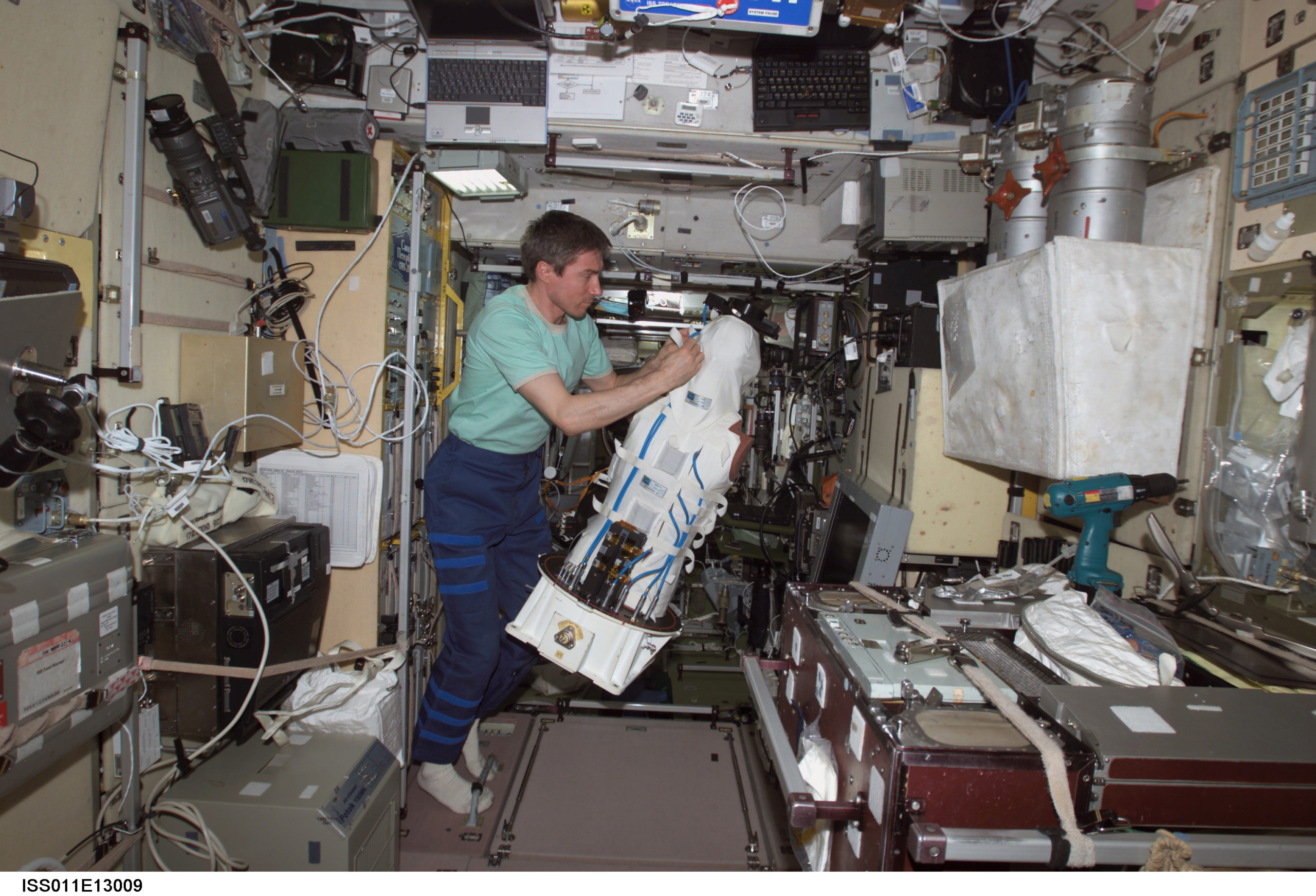
is a device that releases oxygen via a chemical reaction. The oxygen source is usually an inorganic superoxide, chlorate, or perchlorate. Ozonides are a promising group of oxygen sources, as well. The generators are usually ignited by a firing pin, and the chemical reaction is usually exothermic, making the generator a potential fire hazard. Potassium superoxide was used as an oxygen source on early crewed missions of the Soviet space program, in submarines for use in emergency situations, for firefighters, and for mine rescue.
The Advanced Closed Loop System (ACLS)
The ACLS is an ESA rack that converts carbon dioxide and water into oxygen and methane. This is very different from the NASA oxygen-generating rack that is reliant on a steady supply of water from Earth in order to generate oxygen. This water-saving capability will reduce the need to launch an extra 400 liters of water in cargo resupply per year. 50% of the carbon dioxide that it processes can be converted to oxygen and by itself it can regenerate enough oxygen for 3 astronauts. The other 50% of carbon dioxide is jettisoned from the ISS along with the methane that is generated. ACLS has three subsystems :
The Carbon dioxide Concentration Assembly (CCA)
uses an amine reaction to absorb and concentrate carbon dioxide from cabin air to keep carbon dioxide within acceptable levels.
The carbon dioxide is removed from the station air by an amine scrubber
the Carbon dioxide Reprocessing Assembly (CRA)
A ‘Sabatier reactor’ reacts CO2 from CCA with hydrogen from the OGA to produce water and methane.
the amine is removed from the scrubber by steam and converted to methane and water by a Sabatier reaction using hydrogen electrolyically produced from water.
The Oxygen Generation Assembly (OGA)
an electrolyser that separates water into oxygen and hydrogen.
The methane is vented, the water is recycled by electrolysis producing hydrogen and oxygen making the cycle repeat
The ACLS is a technology demonstrator (planned to operate from 1 to 2 years) but if it is successful it will be left on board the ISS permanently. It was delivered on the Kounotori 7 launch in September 2018 and installed in the Destiny module. A year after delivery, most of it was working and new parts were expected to get all three subsystems fully functional in 2020.
Power and thermal control.
Solar arrays
Double-sided solar arrays provide electrical power to the ISS. These bifacial cells collect direct sunlight on one side and light reflected off from the Earth on the other, and are more efficient and operate at a lower temperature than single-sided cells commonly used on Earth. Each ISS solar array wing (often abbreviated “SAW”) consists of two retractable “blankets” of solar cells with a mast between them. Each wing is the largest ever deployed in space, weighing over 2,400 pounds and using nearly 33,000 solar arrays, each measuring 8-cm square with 4,100 diodes. When fully extended, each is 35 metres (115 ft) in length and 12 metres (39 ft) wide. Each SAW is capable of generating nearly 31 Kilowatts (kW) of direct current power. When retracted, each wing folds into a solar array blanket box just 51 centimetres (20 in) high and 4.57 metres (15.0 ft) in length.
The Russian segment of the station, like most spacecraft, uses 28 V low voltage DC from two rotating solar arrays mounted on Zvezda. The USOS uses 130–180 V DC from the USOS PV array, power is stabilised and distributed at 160 V DC and converted to the user-required 124 V DC. The higher distribution voltage allows smaller, lighter conductors, at the expense of crew safety. The two station segments share power with converters. The USOS solar arrays are arranged as four wing pairs, for a total production of 75 to 90 kilowatts.

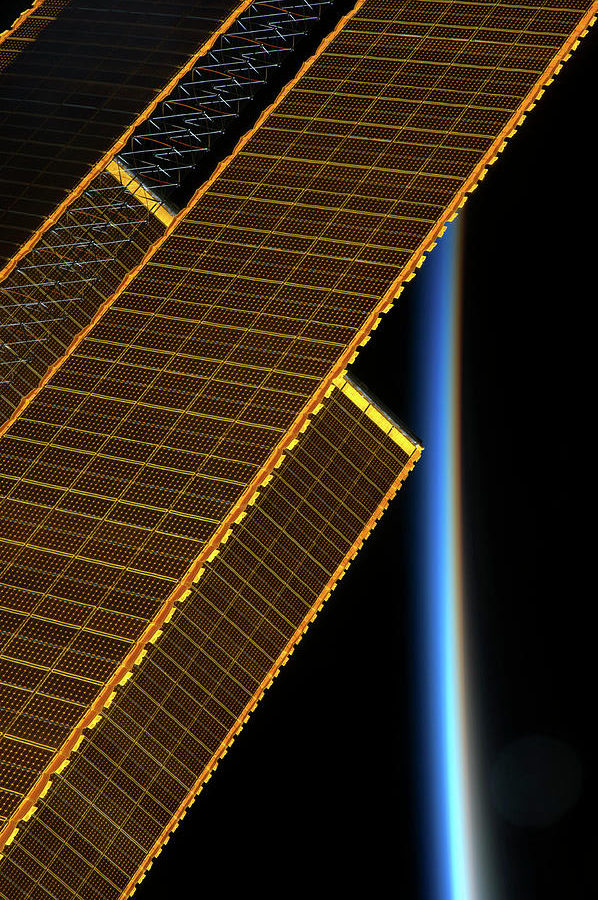
These arrays normally track the Sun to maximise power generation. In the complete configuration, the solar arrays track the Sun by rotating the alpha gimbal once per orbit; the beta gimbal follows slower changes in the angle of the Sun to the orbital plane. The Night Glider mode aligns the solar arrays parallel to the ground at night to reduce the significant aerodynamic drag at the station’s relatively low orbital altitude. Several different tracking modes are used in operations, ranging from full Sun-tracking, to the drag-reduction mode (night glider and Sun slicer modes), to a drag-maximization mode used to lower the altitude.
Altogether, the eight solar array wings can generate about 240 kilowatts in direct sunlight, or about 84 to 120 kilowatts average power (cycling between sunlight and shade).
Batteries
The station originally used rechargeable nickel–hydrogen batteries (NiH2) for continuous power during the 45 minutes of every 90-minute orbit that it is eclipsed by the Earth. The batteries are recharged on the day side of the orbit. They had a 6.5-year lifetime (over 37,000 charge/discharge cycles) and were regularly replaced over the anticipated 20-year life of the station. Starting in 2016, the nickel–hydrogen batteries were replaced by lithium-ion batteries, which are expected to last until the end of the ISS program.
Thermal control
The station’s systems and experiments consume a large amount of electrical power, almost all of which is converted to heat. To keep the internal temperature within workable limits, a passive thermal control system (PTCS) is made of external surface materials, insulation such as MLI, and heat pipes. If the PTCS cannot keep up with the heat load, an External Active Thermal Control System (EATCS) maintains the temperature.
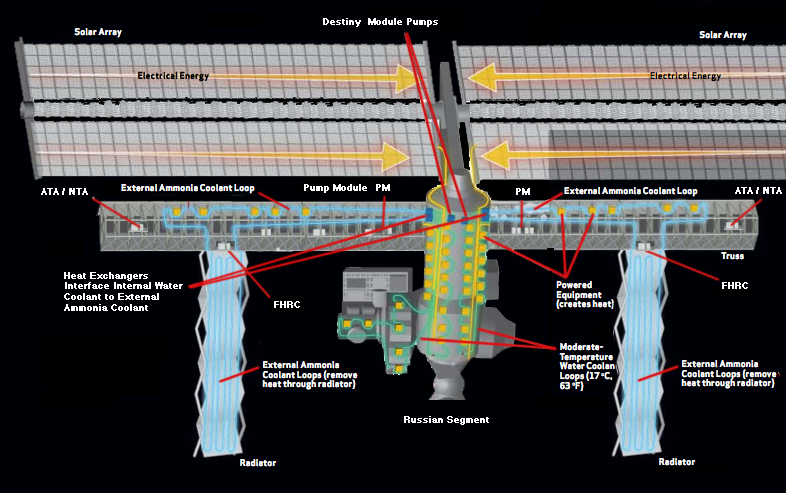
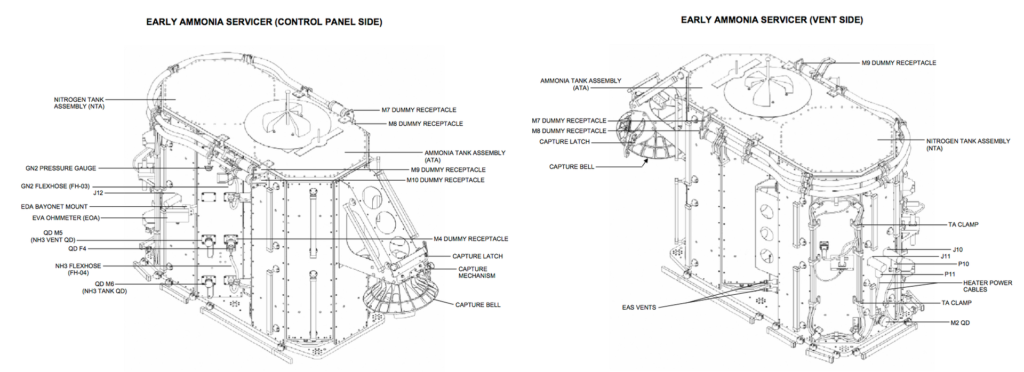
The EATCS consists of an internal, non-toxic, water coolant loop used to cool and dehumidify the atmosphere, which transfers collected heat into an external liquid ammonia loop. From the heat exchangers, ammonia is pumped into external radiators that emit heat as infrared radiation, then back to the station. The EATCS provides cooling for all the US pressurised modules, including Kibō and Columbus, as well as the main power distribution electronics of the S0, S1 and P1 trusses. It can reject up to 70 kW. This is much more than the 14 kW of the Early External Active Thermal Control System (EEATCS) via the Early Ammonia Servicer (EAS), which was launched on STS-105 and installed onto the P6 Truss.
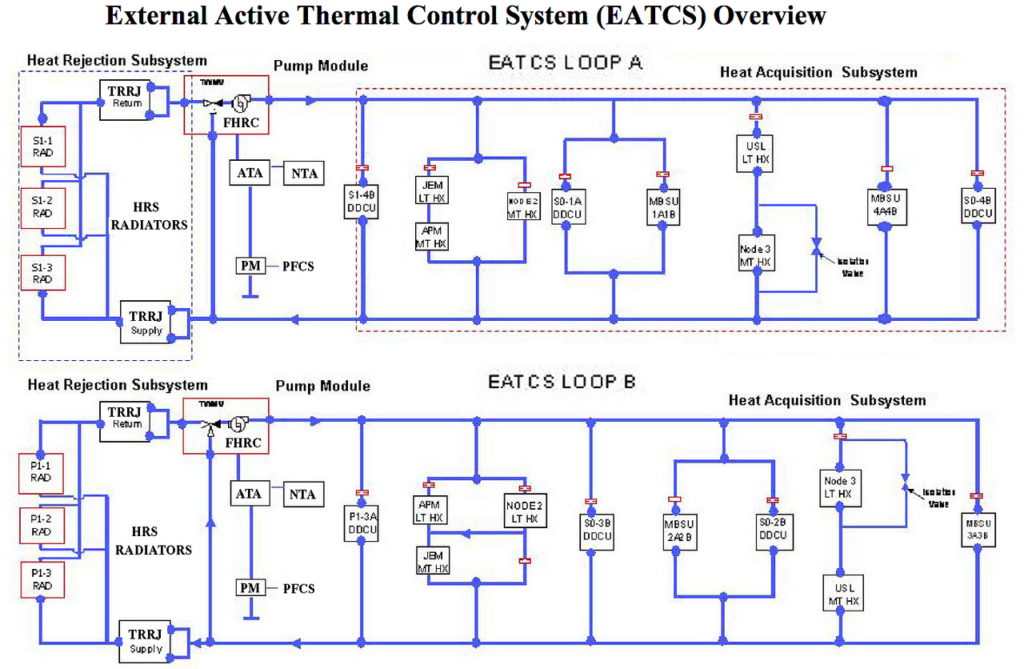
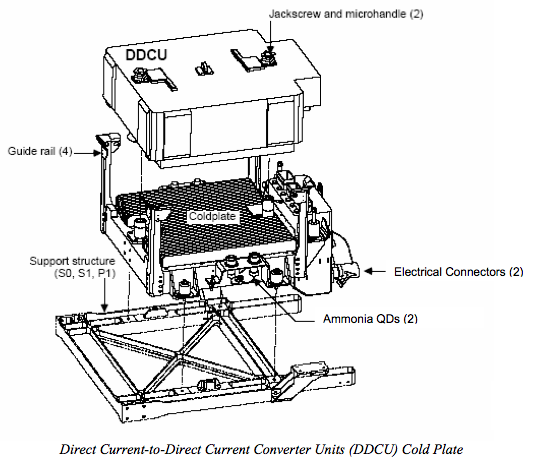
There are two independent Loops (Loop A & Loop B) that combined make up the EATCS. The EATCS Loops perform three primary functions:
- Heat Collection – Each Loop draws heat from five Heat Exchangers (HXs) mounted on the Destiny Laboratory, Node-2 & Node-3 as well as cold plates under three DC-to-DC Conversion Units (DDCUs)
- Heat Transportation – The Pump Module (PM) provides flow and accumulator functions and maintains proper temperature control at the pump outlet for each Loop.
- Heat Rejection – Ammonia passes from the ATA through a two way path of the Flex Hose Rotary Coupler (FHRC) where heat captured while passing through the Heat Exchangers is directed to be expelled through the Heat Rejection System Radiators (HRSRs).
Electrical system of the International Space Station
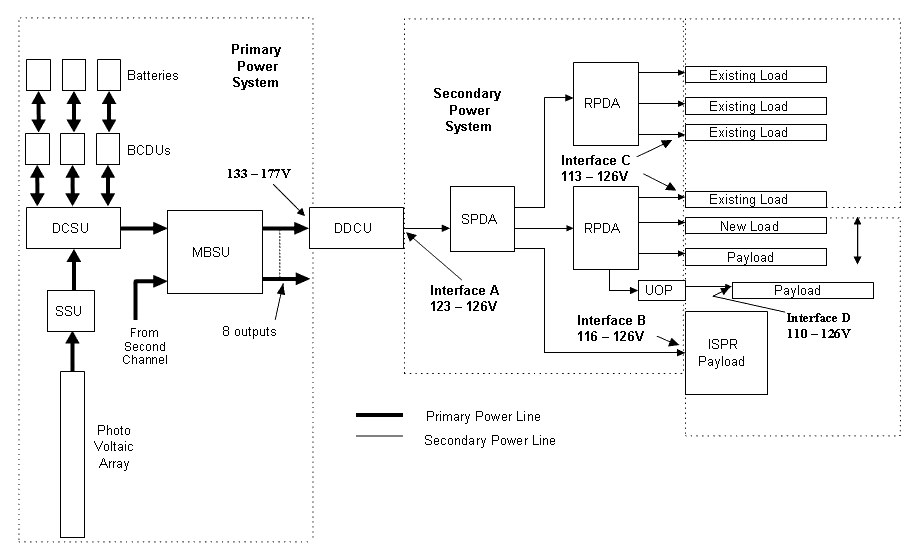
The electrical system of the International Space Station is a critical resource for the International Space Station (ISS) because it allows the crew to live comfortably, to safely operate the station, and to perform scientific experiments. The ISS electrical system uses solar cells to directly convert sunlight to electricity. Large numbers of cells are assembled in arrays to produce high power levels. This method of harnessing solar power is called photovoltaics.
The process of collecting sunlight, converting it to electricity, and managing and distributing this electricity builds up excess heat that can damage spacecraft equipment. This heat must be eliminated for reliable operation of the space station in orbit. The ISS power system uses radiators to dissipate the heat away from the spacecraft. The radiators are shaded from sunlight and aligned toward the cold void of deep space.
No darkness would ever settle upon those lamps, as no darkness had settled upon them for hundreds of years. It seemed dreadful that the town should blaze for ever in the same spot; dreadful at least to people going away to adventure upon the sea, and beholding it as a circumscribed mound, eternally burnt, eternally scarred. From the deck of the ship the great city appeared a crouched and cowardly figure, a sedentary miser.
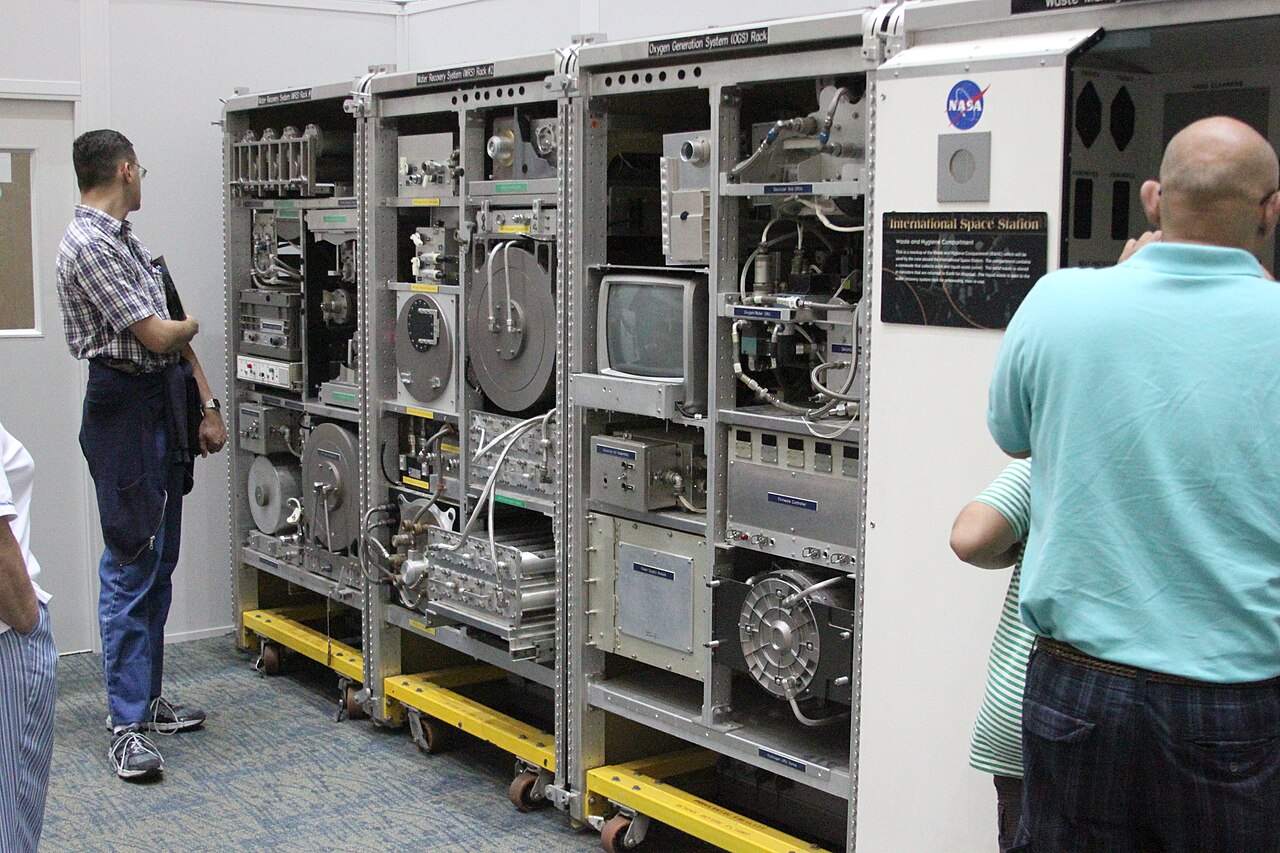
The Water Recovery System consists of a Urine Processor Assembly and a Water Processor Assembly, housed in two of the three ECLSS racks.
The Urine Processor Assembly uses a low pressure vacuum distillation process that uses a centrifuge to compensate for the lack of gravity and thus aid in separating liquids and gasses. The Urine Processor Assembly is designed to handle a load of 9 kg/day, corresponding to the needs of a 6-person crew. Although the design called for recovery of 85% of the water content, subsequent experience with calcium sulfate precipitation (in the free-fall conditions present on the ISS, calcium levels in urine are elevated due to bone density loss) has led to a revised operational level of recovering 70% of the water content.
Water from the Urine Processor Assembly and from waste water sources are combined to feed the Water Processor Assembly that filters out gasses and solid materials before passing through filter beds and then a high-temperature catalytic reactor assembly. The water is then tested by onboard sensors and unacceptable water is cycled back through the water processor assembly.
Water recovery system
The ISS has two water recovery systems. Zvezda contains a water recovery system that processes water vapor from the atmosphere that could be used for drinking in an emergency but is normally fed to the Elektron system to produce oxygen. The American segment has a Water Recovery System installed during STS-126 that can process water vapour collected from the atmosphere and urine into water that is intended for drinking. The Water Recovery System was installed initially in Destiny on a temporary basis in November 2008 and moved into Tranquility (Node 3) in February 2010.

Communication systems
Radio communications provide telemetry and scientific data links between the station and mission control centres. Radio links are also used during rendezvous and docking procedures and for audio and video communication between crew members, flight controllers and family members. As a result, the ISS is equipped with internal and external communication systems used for different purposes.
The Russian Orbital Segment communicates directly with the ground via the Lira antenna mounted to Zvezda. The Lira antenna also has the capability to use the Luch data relay satellite system. Another Russian communications system is the Voskhod-M, which enables internal telephone communications between Zvezda, Zarya, Pirs, Poisk, and the USOS and provides a VHF radio link to ground control centres via antennas on Zvezda‘s exterior. The US Orbital Segment (USOS) makes use of two separate radio links: S band (audio, telemetry, commanding – located on the P1/S1 truss) and Ku band (audio, video and data – located on the Z1 truss) systems. These transmissions are routed via the United States Tracking and Data Relay Satellite System (TDRSS) in geostationary orbit, allowing for almost continuous real-time communications with Christopher C. Kraft Jr. Mission Control Center (MCC-H) in Houston. Data channels for the Canadarm2, European Columbus laboratory and Japanese Kibō modules were originally also routed via the S band and Ku band systems, with the European Data Relay System and a similar Japanese system intended to eventually complement the TDRSS in this role. Communications between modules are carried on an internal wireless network.
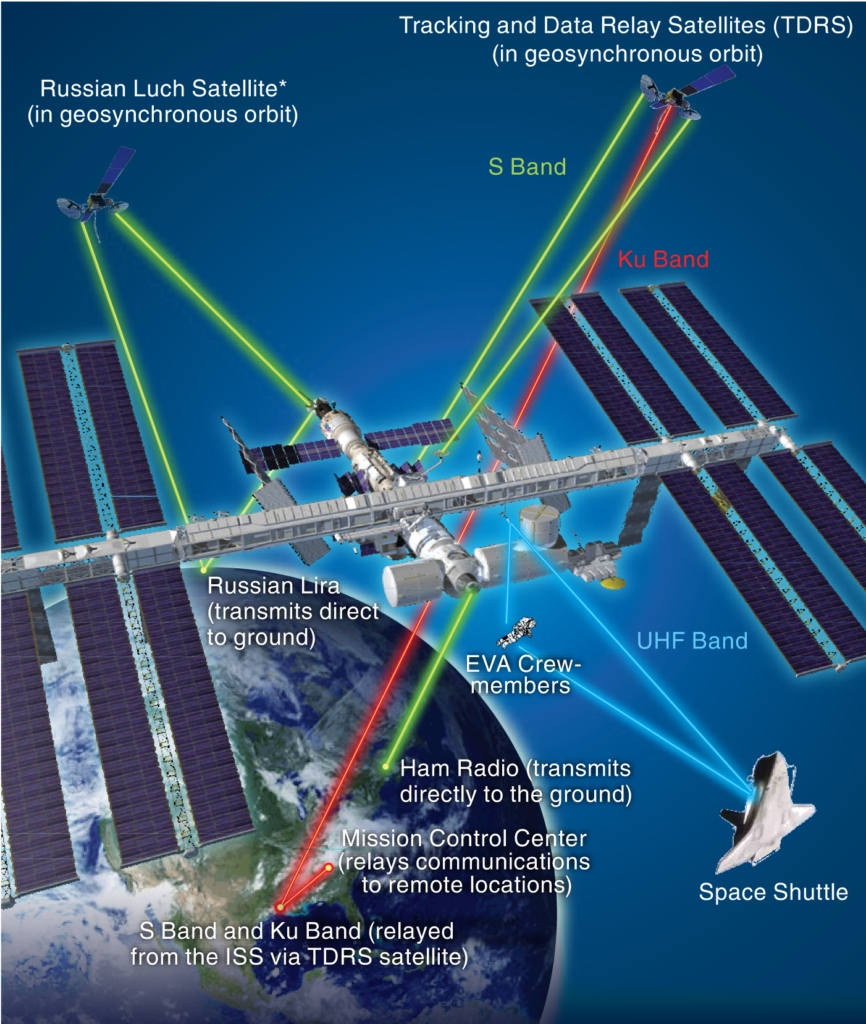
UHF radio is used by astronauts and cosmonauts conducting EVAs and other spacecraft that dock to or undock from the station. Automated spacecraft are fitted with their own communications equipment; the ATV used a laser attached to the spacecraft and the Proximity Communications Equipment attached to Zvezda to accurately dock with the station.
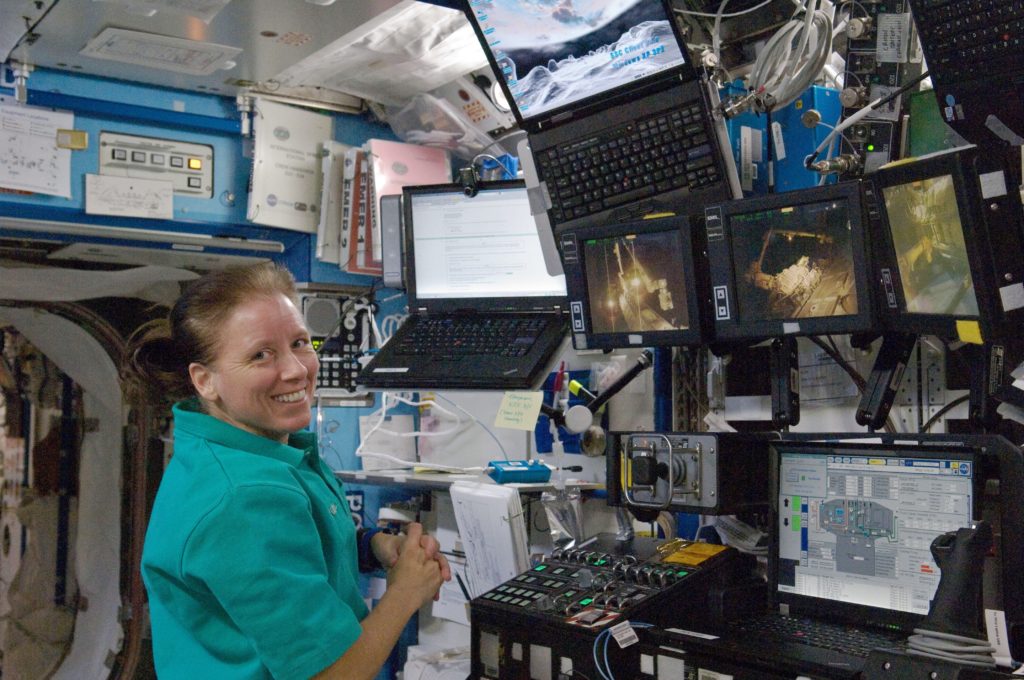
The ISS is equipped with about 100 IBM/Lenovo ThinkPad and HP ZBook 15 laptop computers. The laptops have run Windows 95, Windows 2000, Windows XP, Windows 7, Windows 10 and Linux operating systems. Each computer is a commercial off-the-shelf purchase which is then modified for safety and operation including updates to connectors, cooling and power to accommodate the station’s 28V DC power system and weightless environment. Heat generated by the laptops does not rise but stagnates around the laptop, so additional forced ventilation is required. Portable Computer System (PCS) laptops connect to the Primary Command & Control computer (C&C MDM) as remote terminals via a USB to 1553 adapter. Station Support Computer (SSC) laptops aboard the ISS are connected to the station’s wireless LAN via Wi-Fi and ethernet, which connects to the ground via Ku band. While originally this provided speeds of 10 Mbit/s download and 3 Mbit/s upload from the station, NASA upgraded the system in late August 2019 and increased the speeds to 600 Mbit/s. Laptop hard drives occasionally fail and must be replaced. Other computer hardware failures include instances in 2001, 2007 and 2017; some of these failures have required EVAs to replace computer modules in externally mounted devices.
The operating system used for key station functions is the Debian Linux distribution. The migration from Microsoft Windows to Linux was made in May 2013 for reasons of reliability, stability and flexibility.
In 2017, an SG100 Cloud Computer was launched to the ISS as part of OA-7 mission. It was manufactured by NCSIST of Taiwan and designed in collaboration with Academia Sinica, and National Central University under contract for NASA.
ISS crew members have access to the Internet, and thus the web. This was first enabled in 2010, allowing NASA astronaut T.J. Creamer to make the first tweet from space. Access is achieved via an Internet-enabled computer in Houston, using remote desktop mode, thereby protecting the ISS from virus infection and hacking attempts.